 Neatkept
Winter gear swap: how to bring skis, boots and sledges in and put summer things away
The first cold week arrives and the skis are somewhere behind the garden furniture. A swap done in an afternoon, with a list, ends the hunt.
Updated
Do the swap twice, and do it early
Seasonal gear spends most of the year in storage and then everyone needs it in the same week. The first snow arrives, someone asks where the sledge is, and the answer is "in the storeroom, somewhere". Nobody enjoys an hour in a cold storeroom with a toddler waiting at the door.
The fix is to treat the change of season as a small job in its own right. Two afternoons a year, one for bringing winter things in and one for putting them away, are enough. The best moment is before you need the gear. At that point a broken buckle is a small repair. In the first cold week it is a problem.
Start by laying it all out
Take every winter thing out of where it was kept and put it in one place: skis, boots, helmets, gloves, snow trousers, sledges, ice skates, snow shovels, boot spikes. Seeing it all together tells you what you have, what is missing and what is doubled.
Then go through it one thing at a time and ask three questions:
- Does it work? Check zips, buckles, straps, bindings, laces, runners and helmet straps. Look for cracks in plastic sledges and for soles that have started to separate.
- Does it still fit? Anything a child wears gets tried on now. Outgrown things go in a separate pile straight away.
- Do we use it? Three pairs of gloves per person and a pair of skates nobody has worn for four winters can go. Pass on what is still good to someone who will use it.
Make a short "fix or buy" list as you go: wax for the skis, a new helmet for the younger one, replacement laces. Doing this in November leaves time to shop around, or to look for second-hand.
Clean and dry before it goes in
Anything that goes into storage wet or dirty comes out smelling or damaged next year, so this step is the one that pays back most. In spring, when the winter gear goes away, do the same.
- Boots: dry fully, take out removable liners, brush off salt and mud.
- Skis and boards: wipe them dry, and wax them before storage if you can, since a coat of wax protects the base over summer.
- Metal parts: edges, buckles and blades rust. Dry them and wipe with a lightly oiled cloth.
- Clothes and gloves: wash according to the label, dry completely and store clean.
- Sledges and skates: wash off mud and salt, dry the blades and store them in soft guards or a cloth wrap, not hard plastic ones.
Pack by sport, not by item
When you need the skis, you also need the boots, the helmet and the poles. When the children go sledging, you want hats, gloves and the sledge. Keep things together by activity instead of by type:
- Downhill: skis or board, boots, helmet, goggles, gloves, poles.
- Cross-country: skis, boots, poles, a small waxing kit.
- Skating: skates, guards, a towel, thin gloves.
- Sledging and snow play: sledges, spare gloves, hats, a thermos bag.
- Everyday winter: snow shovel, boot spikes, ice scraper, a spare scarf.
One box or bag per activity, and for each person if the family is big, means one thing to carry to the car or the door. Long things such as skis and poles live in a rack or against a wall, tied together as a pair, with the box for the same sport right beside them.
Label it, and write down what's inside
A box marked "winter" doesn't help much if you have six of them. Put on each box:
- the activity and person: "Downhill, Anna";
- a number: 1 of 3, so you know when you have found everything;
- the three main contents, in a few words.
Then keep a very short list somewhere you will see it: inside the lid of box 1, on your phone or on the inside of the storeroom door. For each box, write the number, where it lives and what's in it. Add the things you don't have yet. A list like that takes ten minutes to write when you pack and saves much longer when you unpack.
Put summer gear where winter gear was
The swap works because one lot goes in as the other goes out. Bikes, camping chairs, sandals, paddling gear and garden cushions take the place of the sledges. Choose spots for each season so that the thing you need now sits at the front, low or near the door, and the thing you won't need for half a year sits high or at the back.
Keep the storage dry and out of strong heat. A loft that gets very hot or a cellar that gets damp is hard on boots, rubber and foam. If the gear has to live in a garage, put it on shelves rather than on the floor.
If your things are spread over more than one home, such as a flat and a family cabin, decide where each set lives. "The skis are at the cabin" is a good answer in February and a bad one on the day you drive to the mountains without them.
Doing it with Neatkept
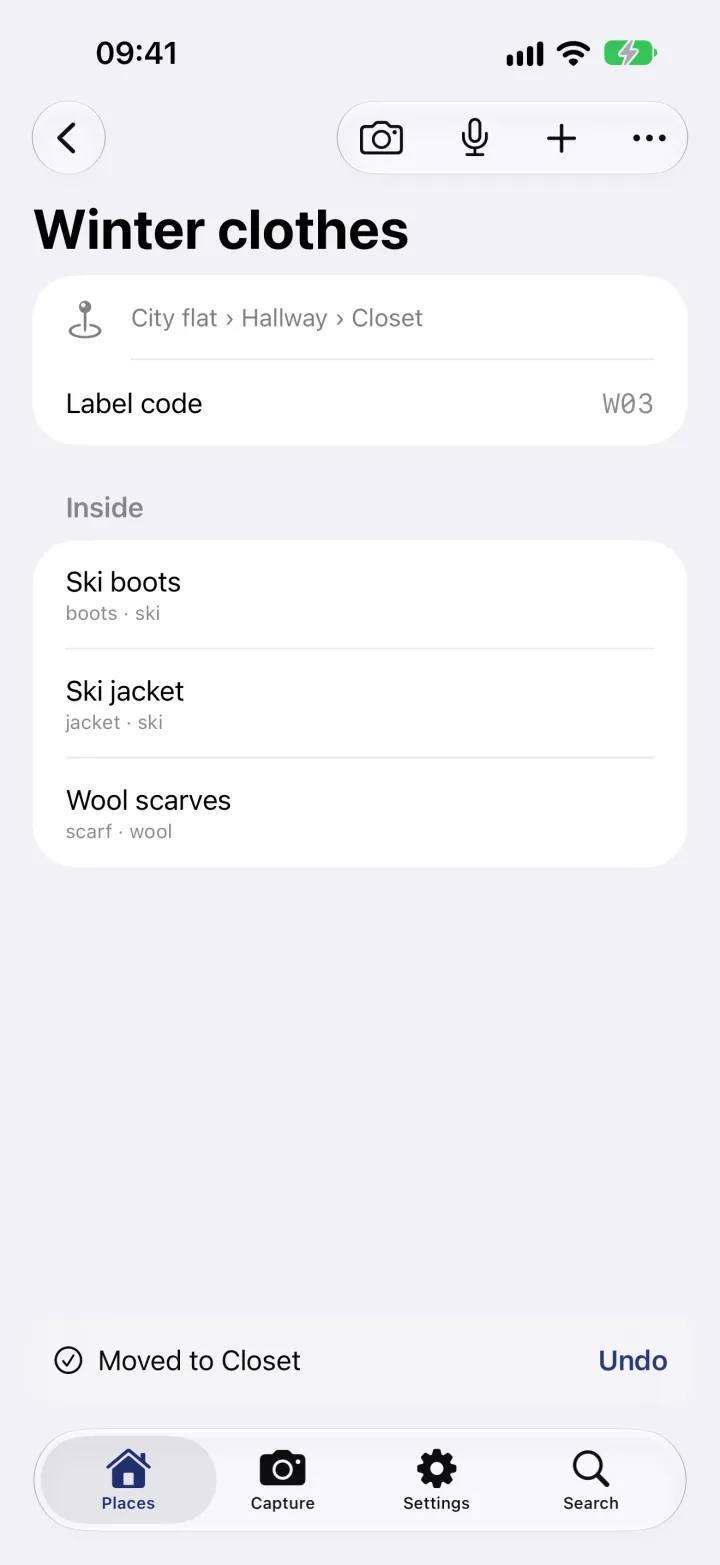
If you want the list to write itself, Neatkept does the boring part. Photograph each open box and AI proposes what is inside, and you keep or drop each thing with a tap. Print a QR label for the box or write a short code such as W01 on it with a marker and the app reads your handwriting. Later, ask for "kids' skis" and you get the place, the box and a photo. When you take the skis to the mountains, put them in With me, so they are listed as with you until you put them back. The seasonal swap page shows the steps.
Questions and answers
When should I do the swap?
Before you need the gear, not on the morning you need it. Late October or early November is a good time for winter things, because there is still time to repair, replace or buy used. Do the reverse in spring, once the cold weather is really over.
How do I store ski boots between seasons?
Dry them completely, loosen the buckles and keep them upright in a cool, dry place. Don't leave them in a hot loft or a damp cellar, and don't stack a heavy box on the shells. Take out the liners if they are removable and let them air first.
What do I do with outgrown children's gear?
Try it on at the start of the swap, not in the shop. Pass on, sell or donate what no longer fits while there is still time to find the next size. Skis and boots that fit last year often don't this year.
Should skis be stored flat or standing up?
Either works if they are dry and clean. Standing in a rack or strapped together with the bindings relaxed is fine, and flat on a shelf is fine too. Avoid leaning them at a steep angle for months or stacking weight on top of them.
Neatkept for this
Seasonal swap
Winter is coming. The box with the ski clothes is in the house's attic, and you live in the city flat.
Boxes labelled with a marker
No printer, no stickers, just a marker. You write K01 on the box of kids' toys and still find out what's inside without opening it.
Find anything in seconds
Your child needs the skis on Saturday, and you have a flat, a house and a garage. Ask once and know where to drive.
All your places
Every home you have, in one tree. Things sit in a box or right on a shelf, and each one has a full path.
Labels and box codes
A QR label or a code written with a marker. Either one opens the box in Neatkept.
Capture from a photo
Photograph an open box or a shelf. Neatkept lists what it sees, and you decide what to keep.
Search in your own words
Ask the way you'd ask a person. Neatkept answers with the home, the room, the box and a photo.